

biosafety-cabinet-nsf49-field-certification-testing
Biosafety Cabinet (BSC) Field Physical Performance Testing & Containment Certification Aligned with NSF/ANSI 49 Standard
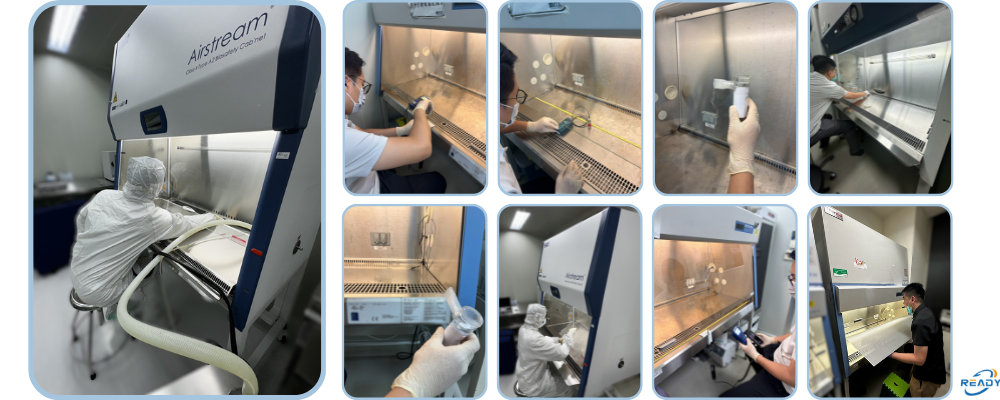
In biopharmaceuticals (cGMP), virology research, cell therapy, clinical pathology, and biosafety laboratories (BSL-2 / BSL-3), **Class II Biosafety Cabinets (BSCs)** serve as primary containment devices designed to prevent biohazardous aerosol release while safeguarding operator health and sample sterility. To ensure continuous compliance with international safety protocols, biosafety cabinets require periodic field certification strictly adhering to **NSF/ANSI 49 (Class II Biosafety Cabinetry)** standards. READY Lab provides professional on-site field certification services across Taiwan.
⁂ Rigorous Compliance with NSF/ANSI 49: Core Field Testing Parameters
Utilizing calibrated reference instruments, our engineering team executes structured physical performance audits across Class II biosafety cabinets (Type A2, B2, etc.):
- Inflow Velocity Profiling: Measuring face suction air velocity at the front sash aperture using thermal anemometers to verify negative pressure containment barriers against aerosol escape.
- Downflow Velocity Profiling: Measuring vertical downflow air velocities across a grid pattern in the work zone to calculate average face velocity and spatial uniformity.
- HEPA/ULPA Filter Integrity Leak Scanning: Introducing PAO/DOP aerosol challenges upstream to scan supply/exhaust filter media, perimeter gaskets, and seals for micro-leaks using photometers.
- Airflow Smoke Pattern Testing: Utilizing high-density aerosol smoke to visualize air streamlines, verifying zero sash spillover, smooth downward intake, and turbulent-free containment barriers.
- Sash Height Alarm & Interlock Audits: Verifying audiovisual alarms and blower interlocks when the front sash is raised beyond designated safe working limits.
- Work Area Lighting Intensity Audits: Measuring workspace illuminance (Lux) across multiple grid points to ensure proper operational visibility.
- UV Germicidal Lamp Intensity Audits: Measuring UVC radiometer output to evaluate germicidal irradiance decay and operational safety limits.
⁂ The Necessity of Periodic NSF-49 Field Certification
Biosafety cabinets represent the frontline containment barrier protecting laboratory personnel and facility environments. Blower motor aging, HEPA filter saturation, or micro-pinhole leaks cannot be detected visually:
- Preventing Personnel Biohazard Exposure: Deficient inflow velocity results in aerosol spillover, exposing operators to hazardous biological materials.
- Preventing Sample Cross-Contamination: Non-uniform downflow or media leaks allow airborne contaminants to enter the workspace, compromising cell cultures.
- Meeting Audit Requirements: NSF/ANSI 49 is the benchmark reference cited by global inspection bodies (CDC, WHO, TFDA, GMP, ISO 14644) during facility quality audits.
⁂ Taiwan-Wide On-Site Technical Services & Formal Documentation
READY Lab's service network covers all of Taiwan—including major science parks, medical centers, and biotechnology clusters in Taipei, Hsinchu, Taichung, and Tainan. We deploy trained engineers equipped with traceable standards directly to your site to execute tests and deliver audit-ready technical certification reports.
? Contact Us | Schedule Biosafety Cabinet NSF-49 Field Testing
If your laboratory Class II Biosafety Cabinet (BSC) is due for annual certification under NSF/ANSI 49 standards, HEPA filter leak scanning, or velocity balancing, contact READY Lab today for technical support.
☎︎ Tel: 02-8228-0131
✉︎ E-mail: Ready_lab@outlook.com